SEO for Websites
Ranking on Google is valuable, but traffic alone does not grow a business. A conversion-focused SEO strategy helps your website attract the right visitors, guide them through clear content and turn more of them into qualified leads.
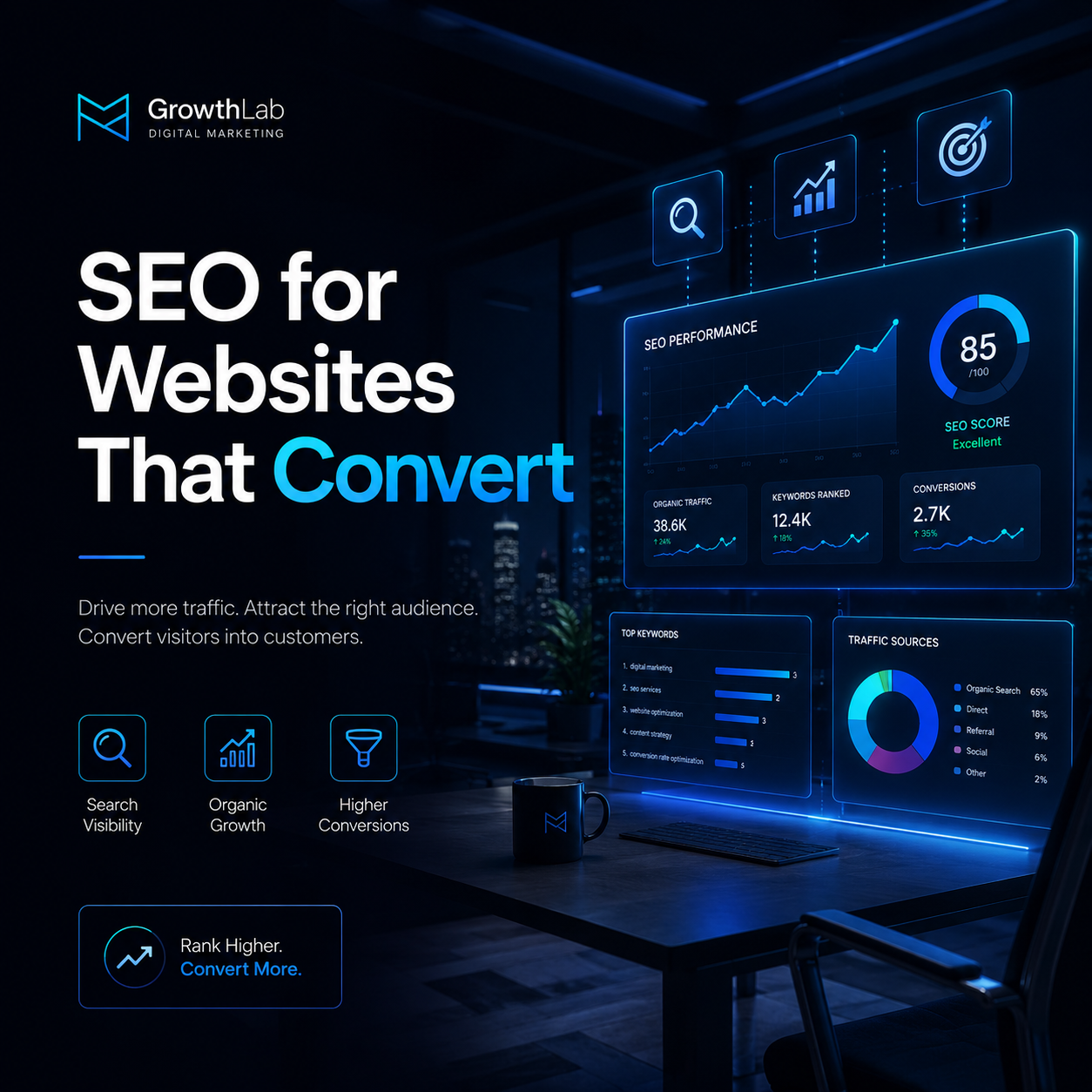
SEO Should Do More Than Bring Traffic
Many business websites are built with one goal in mind: get more visitors. But for service-based businesses, local companies and growing brands, the real goal is not simply traffic. The real goal is to attract people who are ready to take action.
That is where SEO for websites that convert becomes important. It combines search strategy, website design, content structure, user experience and lead generation so your website does not just rank. It helps visitors understand your value, trust your business and enquire with confidence.
A strong SEO strategy should connect naturally with your website design and development, your digital marketing and lead generation, and the systems you use to follow up with enquiries, such as CRM and automation.
A high-performing website is not just a digital brochure. It is a connected sales asset designed to attract, educate, qualify and convert the right audience.
In This Guide, You Will Learn
This guide explains how to approach SEO with conversion in mind, especially if your business depends on enquiries, bookings, calls, consultations or quote requests.
How SEO and conversion work together
Understand why rankings, content, user experience and clear CTAs need to support the same business goal.
What pages to optimise first
Learn which pages usually have the biggest impact on leads, including service pages, location pages and blog content.
How to create content with intent
See how educational content, comparison pages and problem-solving articles can attract more qualified visitors.
How to turn traffic into enquiries
Use better page structure, trust signals, internal links, CTAs and CRM follow-up to improve conversion.
What Is SEO for Websites That Convert?
SEO for websites that convert means optimising your website for both search visibility and business outcomes. Instead of treating SEO as a checklist of keywords, headings and backlinks, it focuses on what happens after someone lands on your website.
Traditional SEO vs Conversion-Focused SEO
Traditional SEO often focuses on rankings, impressions and organic traffic. Those metrics matter, but they do not always show whether your website is generating useful enquiries.
Conversion-focused SEO looks at the full journey. It asks whether your content matches search intent, whether the page answers the visitor’s questions, whether the offer is clear, and whether the next step is easy to take.
Attract
Target keywords and topics your ideal customers are actually searching for.
Educate
Use clear content to explain problems, solutions, pricing factors and next steps.
Convert
Guide visitors towards enquiries, bookings, quotes or strategy calls with strong UX.
A page ranking for “website design Sydney” should not only explain your design service. It should show your process, examples, trust signals, benefits, FAQs and a simple way to start a conversation.
The SEO Foundation Every Conversion Website Needs
Before a website can convert well from organic traffic, it needs a strong SEO foundation. This includes technical structure, page speed, search-friendly content and clean navigation.
1. Clear Search Intent
Every page should have a clear purpose. A service page should help someone evaluate your offer. A blog should answer a specific question. A landing page should move the visitor towards one action.
For example, someone searching “how to get more leads from my website” may need education first, while someone searching “website design agency Sydney” may be closer to making an enquiry.
2. Technical SEO Basics
Your website should be easy for search engines to crawl and understand. This includes clean URLs, correct heading structure, internal links, mobile responsiveness, optimised images, metadata and a sitemap submitted through Google Search Console.
3. Performance and Mobile Experience
Many visitors will first experience your website on mobile. If the page feels slow, cluttered or difficult to navigate, you may lose leads before they read your offer.
4. Measurement Setup
SEO should be measured beyond page views. Tools like Google Analytics can help you understand traffic, user behaviour and key conversion paths. For paid and organic campaigns, Google Ads can also help identify which commercial keywords have stronger intent.

Content That Ranks and Converts
Good SEO content should do more than include keywords. It should help your audience make a decision. That means answering real questions, removing doubts and showing why your business is the right option.
Build Content Around Buyer Intent
Not every visitor is ready to buy today. Some are researching. Some are comparing options. Others are ready to speak with a provider. Your content should support each stage of that journey.
- Awareness content: educational blogs that explain problems, opportunities or common questions.
- Consideration content: comparison pages, process pages, pricing guides and service explainers.
- Decision content: case studies, testimonials, project examples, FAQs and strong enquiry pages.
Use Blog Content to Support Service Pages
Blog content can help attract people earlier in the buying journey. But the article should not be isolated. It should link naturally to relevant service pages, project examples and next steps.
For example, an article about improving website leads can link to your website design and development service, while a guide about follow-up systems can link to CRM automation systems and workflow automation.
Make the Content Easy to Scan
Most users do not read every word. They scan headings, bold phrases, cards, images and CTAs. A strong blog structure makes the page feel helpful before the visitor commits to reading deeply.
Each major section should answer one clear question. If the visitor can understand the article by scanning the headings, the UX is already stronger.
UX and Website Structure Matter for SEO Conversion
SEO brings people to the page. UX helps them stay, understand and act. If your page structure is confusing, your website may generate traffic without meaningful enquiries.
Use a Clear Page Flow
A conversion-focused page should have a logical journey. Start with the problem or desired outcome, explain your solution, show proof, answer objections and then make the next step simple.
Place CTAs Where They Feel Natural
A call-to-action should appear when the visitor has enough context to take the next step. For long-form content, this usually means one CTA near the top, one in the middle and one at the end.
Add Trust Signals
Trust signals help visitors feel confident. These can include testimonials, case studies, portfolio examples, client logos, before-and-after results, process explanations and helpful FAQs.
If you already have completed work, link naturally to your project examples. If you publish educational content, connect it through your insights section.
Strong headline
Make the value clear within the first few seconds of landing on the page.
Readable sections
Break complex topics into short, useful sections with clear headings.
Simple next step
Use one clear action so visitors know exactly what to do next.
Common SEO Mistakes That Reduce Conversions
Many websites struggle to convert because SEO, design and marketing are treated as separate tasks. A website may rank for some keywords but still fail to create enough trust or action.
Mistake 1: Targeting Keywords Without Commercial Intent
Some keywords bring visitors who are not the right fit. A strong SEO strategy balances volume with intent, relevance and the likelihood of generating enquiries.
Mistake 2: Writing for Google but Not for People
Keyword-heavy content can feel robotic. Good SEO copy should be clear, helpful and persuasive while still being structured for search engines.
Mistake 3: Hiding the CTA
If visitors need to search for the next step, many will leave. Make your CTA visible, contextual and easy to complete.
Mistake 4: Not Connecting SEO With CRM or Follow-Up
A website lead is only valuable if the business responds properly. Connecting your website forms with a CRM such as Zoho CRM or tools like HubSpot can help improve lead management and follow-up.
Mistake 5: Publishing Blogs Without Internal Links
Blog posts should support your wider website. Internal links help visitors move from education to action and help search engines understand the relationship between pages.
A Practical SEO Action Plan for Websites That Convert
If you want to improve your website, start with the areas that can create the biggest impact: your main service pages, your highest-intent keywords and your lead capture journey.
Audit your current traffic and leads
Review which pages get traffic, which pages generate enquiries and where visitors drop off before taking action.
Map keywords to the right pages
Assign each focus keyword to a specific page. Avoid making multiple pages compete for the same search intent.
Improve your service pages first
Optimise headlines, content, FAQs, internal links, testimonials and CTAs on your most important commercial pages.
Create supporting blog content
Publish articles that answer common questions and link them to your services, case studies and lead capture pages.
Connect forms with CRM and automation
Send enquiries into a CRM, notify your team and create follow-up workflows so leads do not get lost after submission.
Measure and improve monthly
Track rankings, traffic quality, conversions, form submissions and calls. Use those insights to improve your website over time.
How 3D Marketing Web Approaches SEO and Conversion
At 3D Marketing Web, we look at SEO as part of a wider digital system. A website should be designed to attract the right visitors, explain your offer clearly, capture leads and connect with the tools your business uses every day.
That may include website design, lead generation campaigns, CRM automation, workflow automation and reporting dashboards that help you understand what is working.

Your SEO, website design, content, CRM and automation should work together as one connected growth system — not as separate tools.
FAQs About SEO for Websites That Convert
What is SEO for websites that convert?
It is an SEO approach that focuses on attracting the right traffic and turning more visitors into enquiries, bookings, calls or quote requests.
How does SEO help generate more leads?
SEO helps your business appear when people search for solutions. When the page is structured well, those visitors are more likely to understand your offer and take action.
What pages should I optimise first?
Start with your main service pages, homepage, high-intent landing pages and any blog posts that already receive traffic or support your commercial offers.
How long does SEO take to generate leads?
SEO usually works over time, but improving existing pages, internal links, CTAs and page structure can often improve conversion before major ranking growth happens.
Do I need CRM automation with SEO?
It is not mandatory, but it helps. If your website starts generating more leads, CRM and automation can help your team respond faster, track enquiries and follow up consistently.
Final Thoughts
SEO is not just about getting found. For modern service businesses, it should support the full customer journey — from search intent to page experience, from helpful content to lead capture, and from enquiry to follow-up.
If your website is getting traffic but not enough leads, the issue may not be SEO alone. It may be the way your SEO, content, UX, CTAs and CRM systems are connected.
A website that converts is built with strategy. It helps the right people find you, understand you and take the next step with confidence.
Ready to build a website that ranks and converts?
Let’s review your current website, identify missed SEO and conversion opportunities, and map a clearer path to more qualified leads.